Trump Issues Global Warnings From Greenland to Iran
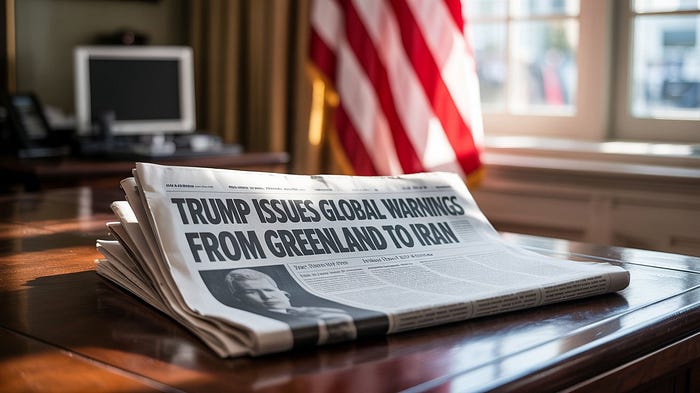
Donald Trump is once again speaking to the world in a language it recognizes instantly. Warnings, not whispers. Pressure, not persuasion. From Greenland to Iran, the message coming out of Trump’s orbit is clear: American power should be asserted openly, and hesitation is a liability.
The remarks, reported across international media, are not tied to a single flashpoint. They span regions, alliances, and adversaries, creating a picture of foreign policy driven less by diplomatic choreography and more by raw leverage. Trump is not signaling a change in tone. He is signaling a return to it.
This approach rejects ambiguity. It treats global politics as a series of pressure tests, where credibility is built by demonstrating a willingness to escalate. Allies are expected to understand the posture. Adversaries are expected to calculate risk quickly. There is little space for subtlety.
What makes this moment notable is not just the rhetoric itself, but how familiar it feels. The world has heard this voice before, and it knows that words, in this framework, are rarely just words.
Greenland, Cuba, and Iran Are Not Random Targets

The countries and territories named in Trump’s warnings are not accidental. Each sits at a strategic pressure point where symbolism, security, and leverage overlap. Taken together, they read less like off-the-cuff remarks and more like a map of unresolved power contests.
Greenland represents Arctic access, military positioning, and long-term geopolitical competition as polar routes open up. Mentioning it signals strategic intent far beyond its population size. Cuba, meanwhile, remains a familiar pressure valve in U.S. politics, a place where hardline rhetoric plays well domestically and sends a clear message about influence in the Western Hemisphere.
Then there is Iran, the most combustible name on the list. Any warning directed at Tehran carries decades of baggage: nuclear ambitions, regional power struggles, and the ever-present risk of escalation. When Iran is invoked, the stakes automatically rise.
What ties these places together is not ideology, but leverage. They are flashpoints where statements alone can move markets, unsettle allies, and force adversaries to respond. This is foreign policy as signal transmission, not quiet negotiation.
Venezuela Returns to the Script and Coup Talk Follows

If Greenland and Iran set the strategic backdrop, Venezuela sharpens the edge. Commentary around Caracas and Nicolás Maduro has reintroduced language that many diplomats prefer retired: regime change, pressure campaigns, and the shadow of coups. The rhetoric does not spell out action, but it flirts with it just enough to command attention.
This is where the temperature rises. Venezuela has long been a stage for maximalist statements that blur the line between warning and threat. Invoking it alongside other flashpoints compresses distance between words and consequences. Allies read it as escalation risk. Adversaries read it as intent testing. Markets read it as volatility.
What makes this moment distinct is the cadence. The language arrives not as a one-off provocation but as part of a broader pattern that prizes leverage over restraint. It is foreign policy spoken loudly, with ambiguity replaced by pressure.
Hard Power Rhetoric Replaces Diplomatic Restraint
What separates this moment from routine political bluster is the philosophy behind it. The rhetoric favors pressure over patience, deterrence over dialogue. It treats international relations less as a negotiation table and more as a stress test, where strength is proven by how openly it is asserted.
This approach sidelines traditional diplomatic restraint. Quiet backchannels, calibrated language, and incremental confidence-building are replaced with blunt warnings designed to travel fast and land hard. The objective is not reassurance. It is dominance signaling. Allies are expected to adjust. Adversaries are expected to flinch.
The contrast with conventional diplomacy is stark. Where diplomats aim to reduce miscalculation, hard power rhetoric accepts it as collateral. Where ambiguity once created space to de-escalate, clarity now sharpens the edge. The risk is obvious. When words are designed to intimidate, they also narrow the exit ramps.
Strategy or Spectacle, the World Is Still Guessing

This is the question hanging over Trump’s global warnings, and it refuses to settle. Is this calculated deterrence, carefully designed to project strength and force recalibration? Or is it spectacle, rhetoric meant to dominate headlines and unsettle rivals without a clear endgame?
Supporters argue the approach is deliberate. Loud warnings create leverage. Unpredictability keeps adversaries cautious. Silence, in this view, invites testing. Critics see something else entirely: a pattern of escalation that compresses decision-making windows and increases the risk of miscalculation across already tense regions.
What complicates the answer is familiarity. The world has seen this style before. It remembers moments when threats stayed rhetorical and moments when they did not. That history makes every new warning heavier, harder to dismiss as noise.
For allies, the calculus is uneasy. For adversaries, the signals are studied line by line. And for everyone else, the uncertainty itself becomes the destabilizing force.


Comments
Post a Comment